

ENEROC Lithium Battery Technology
Smart Factory
The ENEROC manufacturing facility is a state-of-the-art smart factory spanning 307,000 square feet, including a production and testing area, a battery cell automated warehouse, and an R&D and testing laboratory with 22,000 square feet of its own space.
4 battery pack production lines have a production capacity of 700 units/day
4 module production lines have a production capacity of 3520 units/day
50 AGVs (Automated Guided Vehicles) move loads throughout the facility
4 laser welding stations; airtight manufacturing rooms

Quality Control and Battery Testing
Reliability is non-negotiable in industrial equipment, which is why every ENEROC battery is built with CATL cells with a failure rate of one in a billion. We continuously test our products at every stage of manufacturing, totaling 3,600 quality control points and 48 dedicated testing instruments.
Comprehensive testing of battery cells, packs, and system integration
42 testing stations, covering electrical performance, mechanical reliability, environmental performance, and functional safety
UL and SGS-certified, IP-rated batteries are subjected to rigorous testing, including vibration, drop, salt spray, and rain exposure.
Extended life expectancy 12 years or up to 4,000 cycles, backed by a 6-year warranty


CATL LFP Battery Cells for Industrial Motive Power
Industrial-Grade Lithium Prismatic Battery Cells by the World's #1 Battery Maker
ENEROC is backed by CATL — the world's #1 lithium battery cell manufacturer — to deliver proven, reliable motive power batteries. CATL's industry-leading manufacturing process achieves an exceptional defect rate of one part per billion (PPB).

ENEROC Batteries Feature a Built-in Fire Extinguisher
Every ENEROC Battery Comes Standard with a Built-In Fire Extinguisher
ENEROC’s latest lithium battery models feature the Flexible Temperature-Sensing Self-Activating Fire Extinguishing Device, or simply, a built-in fire extinguisher. This innovative device is designed to detect and extinguish fires in small, enclosed spaces without requiring electrical control systems. The device features a temperature-sensitive tube filled with a clean extinguishing agent, such as perfluorohexanone or heptafluoropropane. When the surrounding temperature reaches a critical threshold (230° F / 110° C, ±10%), the tube automatically ruptures to release the agent and suppress the fire within seconds. The system is reliable and leaves no residue or pollution.
Fire Extinguished in Just 2 Seconds
The ENEROC battery management system (BMS) will automatically shut down the battery and alert the user if the internal temperature rises above the safe limit (230° F / 110° C). If the temperature rises to the critical limit, the built-in fire extinguisher activates automatically.
The device is highly effective, with a tested fire extinguishing time of just 1.9 seconds. Its autonomous fire detection and suppression capability dramatically reduces the risk. The clean extinguishing agent is electrically safe and equipment-friendly, ensuring operations can resume quickly.
The length and routing of the extinguishing tube vary depending on the battery pack capacity and internal layout. The tube diameter is generally standard, but the tube length and placement are adjusted according to the available internal space and the areas requiring thermal coverage.

ENEROC Batteries Feature a Proprietary Battery Management System (BMS)
ENEROC uses a proprietary battery management system (BMS) design
The BMS is the battery's 'brain' — continuously monitoring cell status, reporting state of charge (SOC), managing charging cycles, optimizing performance, and triggering automatic shutdown if a safety risk is detected.
-
CAN Communication
-
Cell Balancing Technology
-
Precise Parameter Collection
-
Energy Management
-
SOX Algorithm (State of Charge, State of Health, etc.)
-
Charge And Discharge Control
-
Thermal Management
-
Large-screen data display
-
Real-time fault discovery and alerts

ENEROC 4G Module: Real-Time Battery Monitoring from Anywhere
Stay Connected to Your Fleet: Remote Monitoring and OTA Updates via 4G
ENEROC 4G module connects the battery BMS to the cloud and provides users with remote access to battery parameters in real time. It automatically collects and analyzes data to optimize performance and maintenance, and sends timely alerts. It enhances fleet management capabilities and enables over-the-air (OTA) battery software updates without requiring on-site service.
-
Easy Access to Data. The cloud platform can be accessed from a PC or an Android mobile device
-
Real-Time Status Updates. Voltage, current, temperature, SOC and SOH parameters are streamed to the cloud continuously
-
Faulty Battery Localization. An alarm is sent when the BMS reports a fault. A faulty battery can be localized and diagnosed remotely.
-
Data Analysis for Fleet Management Systems
-
Remote Upgrades. 4G module allows for software upgrades

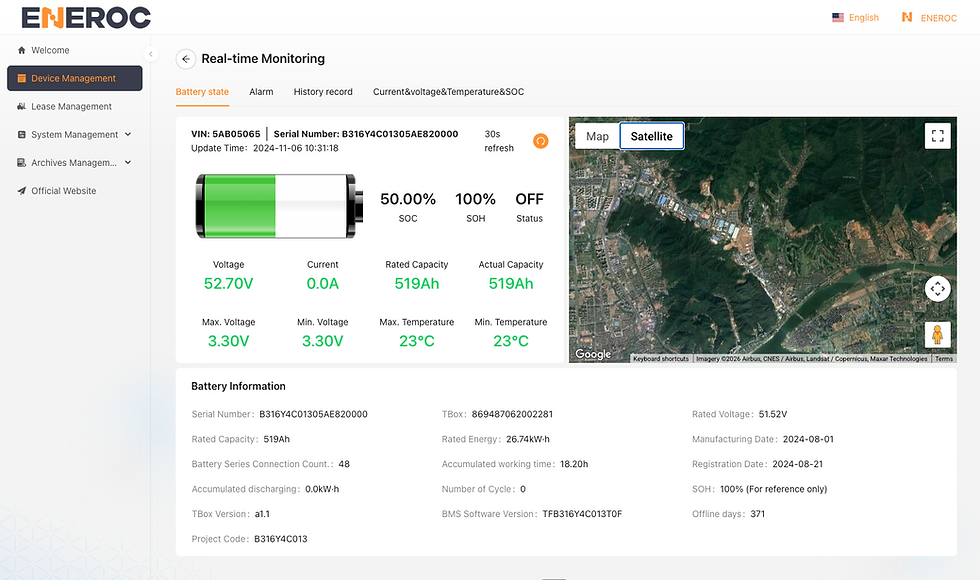

ENEROC Cloud: iot.enerocbattery.com
ENEROC battery users can reliably and safely access their battery data from any location globally by connecting to www.iot.enerocbattery.com with a unique user login.
Main characteristics of lithium cell chemistry types
Battery cells are mainly defined by the following:
Specific energy (how much energy a system contains in comparison to its mass; typically expressed in watt-hours per kilogram, Wh/kg);
Specific power (the amount of power in a given mass; typically expressed in watts per kilogram, W/kg);
Cost (influenced by the rarity and cost of raw materials, and by technological complexity);
Safety (risk factors, like temperature threshold for thermal runaway);
Lifespan (the number of cycles leading to a critical decrease of capacity, usually 80% in material handling applications);
Performance (capacity, voltage, and resistance).

Which Lithium Chemistry Is Right for Your Application?
Lithium cells are named after the chemical composition of their cathode material, which has the greatest influence on battery performance characteristics. There are multiple cathode materials to choose from within the Li-ion technology space. The best-known active component of the cathode is cobalt, widely used in batteries for electronics and EVs. Today, battery manufacturers using cobalt are facing serious supply-chain and sustainability issues (like unethical mining practices, including the use of child labor). Cobalt is frequently substituted with iron (LFP), nickel, manganese, and aluminum.
Of all the various types of lithium-ion batteries, three cell chemistry types emerge as widely used in on- and off-highway electric vehicles: lithium ferrophosphate, or lithium iron phosphate (LFP), lithium nickel manganese cobalt oxide (NMC), and lithium nickel cobalt aluminum oxide (NCA).
All batteries degrade with usage, decreasing their Ah capacity with each charge/discharge cycle. In material handling applications batteries are considered end-of-life when capacity drops below 80% of nominal.
A battery’s longevity, or its cycle life, depends on three main factors:
-
chemical composition of cathode materials;
-
ambient temperature of operation;
-
depth of discharge.
The graph below shows the results of independent degradation tests of the three types of cells with different chemistries, under equal conditions of temperature and depth of discharge.
One “equivalent full cycle” is the sum of charge/discharge events that add up to one full (zero to 100%) charge and one full (100% to zero) discharge of a battery.
LFP lithium batteries exhibit superior performance compared to NMC—they offer a longer lifespan and are generally less expensive. Lithium nickel cobalt aluminum oxide (NCA) batteries performed similarly to or worse than NMC.
Apart from longer cycle life, LFP wins on safety, with better stability and a higher thermal run-away temperature threshold (roughly 420°F for NMC and 520°F for LFP).
NMC chemistry is higher on specific energy, which means NMC cells have higher energy density than LFP. This is important for electronics and electric vehicles, where battery weight is a decisive factor (the lighter the better). On the other hand, industrial batteries for material handling applications are often engineered as a counterweight (the heavier the better).
Lithium Ferrophosphate (LFP)
LFP is a popular, cost-effective cathode material for lithium-ion cells that are known to deliver excellent safety and long lifespan, making it ideal for industrial battery applications requiring high load currents and long cycle life.
An LFP cathode offers several key advantages, including a high current rating, long cycle life, and superior thermal stability, which makes it one of the safest and most abuse-tolerant cathode material options. LFP delivers a lower nominal voltage, which results in lower specific energy than other cathode materials. LFP batteries tend to have a somewhat higher self-discharge than other Li-ion battery types.
-
Excellent charge and discharge rate capability
-
Superior low-temperature performance
-
Stable resistance
-
Stable voltage drop under life cycle testing in high-temperature environments
Lithium Nickel Manganese Cobalt Oxide (NMC)
One of the most widely used Li-ion cathodes is obtained by combining nickel, manganese, and cobalt. Lithium nickel manganese cobalt oxide (LiNiMnCoO2), or NMC, has become the go-to cathode material to develop batteries for power tools, e-bikes, and other electric powertrains. It delivers strong overall performance, high specific energy, and a low self-heating rate. This cathode power is used for EV batteries (Tesla used both NMC and NCA, but switched to LFP in the latest models).
The NMC formula typically consists of 33% nickel, 33% manganese, and 33% cobalt. This blend, sometimes referred to as 1-1-1, is a popular option for mass-produced cells in applications requiring frequent cycling (automotive, electronics) due to the reduced material cost with a lower cobalt content.
Lithium Nickel Cobalt Aluminum Oxide (NCA)
A lithium nickel cobalt aluminum oxide, or NCA, battery shares similarities with the NMC by offering high specific energy, reasonably good specific power, and a relatively long life span, making NCA a candidate for EV powertrains. The main downsides are safety and cost, as well as the recent supply chain issues.